Monday, October 26, 2009

Self, the Origin - Identity - Part 2

Part 1 / Part 2 / Part 3 - Read the Part 1 first.

The Story of the 'Self' - Who am I?
Why do we all look different? What happens if we all look alike? Will the concept of you and me be there? To elaborate on that concept - how do you explain the concept of color to a person born blind? The answer is you cannot. So, if we all start to look the same, the identity of 'self' will not be created, which is required to understand nature to even enjoy the beauty of nature.
The state of Being
Being in a state of connectedness with something immeasurable – almost paradoxically, it is essentially you, yet it is beyond or more significant than you. The inability to feel this connectedness gives rise to the illusion of separation from yourself and the world around you.

Being is deep within you, but you can't grasp it with your logical mind. The rational mind is full of thoughts and restlessness. When the mind is free of thoughts, you are in the present – In the Now.

Rene Descartes made his famous statement, Cogito Ergo Sum – I think, therefore I am. The fundamental error in this philosophy is equating thinking with Being. I feel the Descartes statement needs to be redefined as follows.

 'I think, therefore, I created my Self'

Thinking creates the Self, which traps us in our mind's prison. This makes us believe that we are nothing but our 'Self,' which is in our mind.

Our Emotions
Emotions are our mind's reflection on our body. Anger results from a hostile thought, which (our actions) can be linked to our past or future (threatening your existence). If you stay in the present (In the Now) state and do not think about the past or future, then this hostile thought will never result in Anger.
When you experience pure love or happiness, you actually experience stillness in your mind – you are in Now. Being in Now is negating the Self. Pure love must negate the Self; otherwise, its infatuation is wrapped under the cover of love. Meeting of like minds will eventually result in negating the SelfO Henry's short story Gift of the Magi exemplifies pure love.

"Buddha says that the pain or suffering arises through desire or craving. To free from pain, we need to cut off our desires."

Different forms of fear, like anxiety, stress, tension, worry, etc., are the effect of spending too much time in the future. Other forms of non-forgiveness, like bitterness, grievances, regret, guilt, resentment, etc., are the outcome of living in the past. This is much worse than living in the future because as you grow up, chances of your past increase if you start living in your past.

So, if you see – only the emotion of pure Love results in being in the present – In the Now. The rest of the feelings push you down in the past and carry considerable baggage as you move forward or continuously in the uncertain future, worrying about things that never happened. The key is understanding the essence of pure love – the negation of Self – which means you are ready to sacrifice your 'self' in pursuing the happiness of the other 'self.'

It's interesting to look at some references from religious texts: check for the Bible – Mathew 22:36-40 Christ's message of "Love thy neighbor." Experts (religious) say that's what all the religions say. If that's the case, then why can't a man from an 'A' religion or caste can't get married to a woman from a 'B' religion or caste according to any religious laws. So, all these are exclusive clubs meant to build and strengthen their own clubs – a collection of 'self' evolving into a bigger self rather than negating the Self – achieving the exact opposite of what all religions preach.

Mankind's greatest delight was "Kindness," the Roman philosopher/emperor Marcus Aurelius declared. Philosophers and thinkers echoed his views down the centuries. In the age of the flat world, free market, and the selfish gene, kindness/compassion is seen as a weakness. We fight in the name of religion/caste, color, country, language, etc., doing precisely the opposite of Love Thy Neighbor.

The Mind
Does the mind control you, or do you control your mind? The obvious answer is, 'Of course I control my mind!' The delusion is if we believe I am nothing but my mind – precisely what Descartes said, 'I think, therefore I am.' Can you switch off your mind if you feel you control your mind? Switch off means – Zero thoughts. It will be difficult, and you will probably say no, we can't. Here is an exercise by Eckhart Tolle – Close your eyes and think about the following thought that will come to your mind. You know what it is if it takes Time for your next thought. You have experienced the present – Now.
Consciousness and Thinking are synonymous. Consciousness is a vast ocean, and the process of Thinking is a small island. Thinking gives us the capability to learn, analyze, and decide. Thought cannot exist without consciousness. Enlightenment is a state where you rise above the idea into the broader realm of consciousness.

The Mind and Time
The mind is in love with 'Time'. Without the concept of Time, the thought can't survive. Thoughts shuttle between the past and the future. The happiness resulting from thinking of the past or the future is an illusion. In oscillating between the past and the future, the mind denies the present – 'Now.' Time stands still when you encounter pure love. Your mind is in the state of 'Now.'

What's Time? Time is nature's way of preventing all from happening at once!

Experience requires analysis of multiple 'Nows' (at least two Nows). This creates the impression of 'Time' moving forward. 

References

  1.  Power of Now By Eckhart Tolle
  2. End of Time By Julian Barbour
  3. Quantum Enigma By Bruce Rosenblum and Fred Kuttner
  4. On Kindness By Adam Philips and Barbara Taylor
  5. The 21st Century Brain (Explaining, mending and manipulating the mind) By Steven Rose
  6. Rene Descartes – Wikipedia
  7. Issac Newton – Wikipedia
  8. http://www.allaboutgod.com/love-thy-neighbor.htm 
  9.  http://integral-options.blogspot.com/2009/01/love-thy-neighbour.html  

Monday, October 27, 2008

Self, the Origin - Part 1

Part 1 / Part 2 / Part 3
The Self, the conscious mind (or the soul from a spiritual outlook) - How did we get this? What are the fundamental prerequisites for the birth of 'self'? Before I get deep into that, let me share some of the questions that bothered me since high school.

1.     Why is our vision tuned to the electromagnetic wave's light spectrum (and not radio waves, x-rays, or infrared)?
2.     Why do we reason?
3.     Why do we (humans) all look different (except the identical twins)?
4.     Why do we have just 5 senses and not 3 or 7?
5.     Why do we have our own identity? Why cannot I see/know what others think?

Vision


There are many species where vision is tuned into a different electromagnetic wave spectrum. For example, Bats (dolphins, whales) cannot see how we see our environment. It uses ultrasound signals (Echo Location) to see the objects before it and flies away if it finds one in its path. So, think about it: if we had a vision where we got tuned into ultra-sound or X-rays. You can imagine how we can see things. Imagine seeing your friends as a skeleton (How do you differentiate them?) or a dark object (ultra-sound). The following image shows the electromagnetic wave and its different wavelengths in it.

.


As per the above picture, our vision is tuned somewhere between a wavelength of 10-6 to 10-7 (m), while remotes of TV, DVD players, etc., are turned into 10-6 to 10-3, and some of the bats are tuned into ultraviolet spectrum 10-7 to 10-8 (m). Your favorite FM station is adjusted to wavelength 10 to 102 (m). So, the question remains: why did our vision tune into this spectrum? Let us look at the second question (Why do we reason?) in the series and see if we can connect all these to our ultimate question, the origin of the ‘Self.’

Rational World – Is it really rational?
The thought of a rational world is connected with the fact that it is ordered. The Earth goes around the Sun, The Moon goes around Earth, and there is an order to all these. Events do not happen randomly; they are related in some way. This connection gives birth to the notion of cause and effect. An example. The window breaks because a cricket ball (a British game) strikes a cricket ball, and the ball is hit by a batsman, and he hits it because a bowler bowls it, and so on.

Closely related to causality is the idea of determinism. Determinism implies that the state of the world at one moment suffices to fix its form at a later stage. Determinism was a crucial element in the Newtonian Laws of Mechanics proposed in the 17th century. Example. Positions and Velocities of planets can be determined at any point in our solar system using Newton’s Laws. Newton’s law doesn’t contain time as a direction. So, we can predict future eclipses and retrofit their occurrences in the past. So, if the world is strictly deterministic, all the events are built in a matrix of cause and effect. All religion focuses on cause and effect as a fundamental principle to determine good and bad. Let us move into the 20th century and see what happened to the Newtonian deterministic world. On a side note, thinking about destiny is interesting when you think about causality. In fact, destiny can be defined as the reverse causality where the cause is predated by an effect. Destiny in connection with fate can be discussed later once we get some hold of the origin of the ‘Self.’

The matrix of cause and effect (as a fundamental principle) got into trouble with the discovery of Quantum Mechanics in the 1920s. We found the absence of a deterministic world in the subatomic world. In the atomic world, indeterminism is built into its fabric. Werner Heisenberg’s Uncertainty Principle is an expression of this indeterminism. Numerous tests of quantum mechanics have proved/confirmed that uncertainty is inherent in quantum systems (at the subatomic level). So, does this mean that the universe is irrational after all?

Not at all.

The effects of quantum mechanics are not noticeable at the macroscopic scale. This means in the observable universe, nature tends to follow deterministic laws. Now, what is the observable universe? Who decides what can be observable? Who is observing whom? That’s another set of questions we need to think about.

The observable universe

The observable universe is the 3+1 dimensional (3 spatial – length, breadth, and height) universe we live in, and adding time as the 4th dimension makes our observable universe complete. However, according to String theory, there are 10+1 dimensions (10 spatial and 1 time) in the universe (that’s the mathematical prediction of string theory and not what we experience as the 3+1 dimensional universe). So, is the current observable 3+1-dimensional universe only for the human species? We may not be able to answer an interesting question soon. Think about a 2+1 dimensional world where you have 2 spatial dimensions (length and breadth and NO height) along with a one-time dimension. The planet in the 2+1D world (time 3rd Dimension) will be a flatland (Flatland: A Romance of many dimensions 1884 fiction by Edwin Abbot), and the species in that land will be like circles, squares, rectangles, etc.

Consider how these species react when encountering someone from our world (3+1D). Let us take the example from the flatland perspective: if a put a hole in a flat piece of paper (the 2+1 D world of the flatland people) using a pencil, the people in the flatland will see a small circle in their land becoming bigger and bigger then it stops. Now, if we take someone out of that 2D land and bring him to our 3D world and show him exactly what happened, how will he go back and explain to his fellow beings about another dimension. They are going to call him crazy. The following images show the different spatial dimensions.


A 3D projection of a four-dimensional hypercube performing a simple rotation about a plane that bisects the figure from front-left to back-right and top to bottom. Created by Jason Hise with Maya and Macromedia Fireworks.


After looking at all these different dimensions, we can ask again why we are in the 3+1 dimensional world. 3 spatial dimensions are the minimum requirement for the consciousness to reach the level where it can see the universe and try to enjoy the beauty of nature and unravel the mysteries one by one. Imagine if the time dimension is not there. Then, the concept of past, present, and future is gone, and events will unfold randomly. So, for rational thinking or to understand the mysteries of nature, consciousness requires the time factor and the 3 spatial dimensions. Without time, the change will become constant. You can measure the difference only if you can compare it (change) in two time frames. As we live in ‘now,’ we do not see the change as it happens.

Let us recap some of the critical points.
  1.  Why is our vision (mind) tuned to the light spectrum in the electromagnetic wave? That is the best frequency to see and understand the 3+1 (3 spatial, 1 time) dimensional world.
  2. Three (spatial) dimensional space with time as the fourth dimension will be the essential fabric requirement for the brain to develop the concept of ‘self,’ resulting in the ‘self’ trying to understand the universe and how the Self got created in the first place!
  3. Time is a critical dimension (along with the 3 spatial dimensions) for the birth of ‘self.’ Without the concept of past, present, and future, learning and comparing things in this 3+1 space is difficult.
Apart from the above three points, something more is required for the concept of Self to be projected by our mind. A forward direction of time becomes critical for the evolution of consciousness to assemble the necessary events together in a logical order. Before the consciousness (human mind) starts to string things together, it must identify itself first. Let us look at that in the next section (part 2) and address the 3rd question in the series – why do we (humans) all look different (except the identical twins)? We will see that in the next section.


Read more in Part 2 of the series.


References


Vision

Flower-visiting bats need UV vision, as the flowers they visit in the rainforest are characterized by a strong reflection of UV-spectrum light at night.
Ultraviolet vision in mammals is a rarity, known only in a few rodents and marsupials. So, the discovery of UV vision in an echolocating nectar-feeding bat is surprising. Bats orientate primarily by echolocation, but bats do have eyes and make some use of vision. The phyllostomid flower bat is color-blind but UV-sensitive down to a wavelength of about 310 nm. 
Many fish, reptiles, birds, and insects can see ultraviolet light. Some even use pigments that reflect it to attract mates and communicate. However, most mammals have lost the ability to see ultraviolet light and lack the cellular machinery necessary to detect it.
The use of UV vision is associated strongly with UV-dependent behaviors of organisms. When UV light is unavailable or unimportant to organisms, the SWS1 gene can become nonfunctional, as exemplified by coelacanths and dolphins.


Sub Atomic World – Quantum Physics


1. Wikipedia – Quantum Physics

Internet videos

1. David Bohm on perception


2. Holographic Universe - Michael Talbot - 1 of 12


Holographic Universe - 2 of 12


Holographic Universe - 3 of 12


Holographic Universe - 4 of 12


Holographic Universe - 5 of 12


Holographic Universe - 6 of 12

Holographic Universe - 7 of 12


Holographic Universe - 8 of 12


Holographic Universe - 9 of 12


Holographic Universe - 10 of 12

Holographic Universe - 11 of 12

Holographic Universe - 12 of 12

Saturday, March 22, 2008

How our brains see what we cant.

A study on monkeys has shed new light on blindsight, a phenomenon in which patients with damage in the brain's primary visual cortex can tell where an object is, even when they cannot see it.

Professor Tadashi Isa and Dr. Masatoshi Yoshida, who led the study at the National Institute for Physiological Sciences in Japan, said that they had uncovered compelling evidence that blindsight occurs because visual information is conveyed bypassing the primary visual cortex.

Published in the Journal of Neuroscience, their findings have been backed by Japan Science and Technology Agency supported. For their research, the researchers recorded eye movements of the monkeys that had damage to one side of the primary visual cortex.

The animals were trained with an eye movement task for two to three months, enabling them to move their eyes to the correct direction where an object was even on the affected side of their visual fields. The researchers said that the animals' brains became able to feel where an object was without 'seeing' it. Read more ...

Monday, August 14, 2006

New Neurons Need Signals to Survive

The human brain continues to produce new nerve cells throughout its life, and these neurons may be vital to learning further information. But many of these novice neurons wither and die before joining the vast signaling network of their mature peers. New research shows that the presence or absence of further information--represented by the neurotransmitter glutamate--may determine a young neuron's survival.
Image: © VISUALS UNLIMITED/CORBIS
Read more in Scientific American

Friday, April 07, 2006

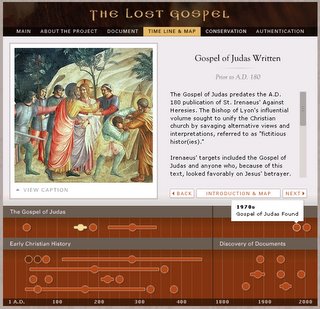
The Lost Gospel

Judas Iscariot is a name synonymous with the word 'traitor.' Here is the history – Judas betrayed Jesus Christ to his enemies (the Roman soldiers) for a mere 30 pieces of silver.
However, in the late 1970s, farmers made a startling discovery in the Egyptian desert, which contained crumbling papyrus documents, 'The Gospel of Judas' and many others, dated around AD 200-400 (using carbon dating).
As per National Geographic, apart from Carbon Dating, the manuscript was also authenticated through Ink Analysis, Multispectral imaging, content, linguistic style, and handwriting style.

In an international effort, the National Geographic Society, in collaboration with the Maecenas Foundation for Ancient Art and the Waitt Institute for Historical Discovery, to translate and authenticate a text called James (also known
as First Apocalypse of James), the Letter of Peter to Philip, a fragment of a text called 'Book of Allogenes' and the only known surviving copy of the Gospel of Judas.

Judas is portrayed as a traitor according to the four Gospels of Mathew, Mark, Luke, and John in the New Testament.
However, The Gospel of Judas shows that he was not only Jesus' favorite disciple but also that Judas' betrayal was a plan between Jesus and Judas. According to Youssef Sidhom, editor of the Coptic Weekly in Cairo, "There is an old school of thought that says one should not persecute Judas because his role was to complete the prophecies. The new manuscript (The Gospel of Judas) seems to support this point of view.

Religious and lay readers will debate the manuscript's meaning and truth. But it does show the diversity of beliefs in early Christianity, said Marvin Meyer, professor of Bible studies at Chapman University in Orange, California


World News

National Geographic:
The Lost Gospel - TimeLine
Times Online: April 06, 2006, Judas did not betray Jesus, lost Gospel claims.

USA
Today: April 6, 2006, 10:13 PM Long Lost Gospel of Judas recasts Traitor
LA Times: April 7, 2006, 
Judas is no Traitor in Long-Lost Gospel
BBC: April 7, 2006, 09:42 GMT Judas' 
helped Jesus save mankind'
ABC Online: April 7, 2006, 08:28:00 AM
Lost Gospel casts Judas in New Light
The New York Times: April 7, 2006, 09:35 AM
Ancient text shows a different Judas
Times of India: Judas did not betray Jesus, says ancient documents


Friday, December 02, 2005

The Future of the Brain

Picower Institute for Learning and Memory held a major scientific symposium entitled "The Future of the Brain" on Dec. 1, 2005. The seminar focused on the future of neuroscience research. MIT president Susan Hockfield opened the day's discussion.

The morning session featured talks by five Nobel Laureates, including Susumu Tonegawa, Director of Picower Institute, and James D. Watson. The afternoon session "Change your mind" focused on the impact of Neuroscience on learning and memory on human health. The second session in the afternoon, entitled "Expand your Mind," looked at the relationship between the human brain and mind.

You can view the entire event here using RealPlayer. Morning Session ( approximately 3:35) Afternoon Session (approximately 3:15 hours) MIT opens the world's largest neuroscience research center

On Friday afternoon, Dec. 2, MIT officially opened the new Brain and Cognitive Sciences Complex (BCS), the largest neuroscience research center in the world. The complex will advance MIT's efforts to address one of the significant scientific challenges of the 21st century: the understanding of the human brain and mind.
For the first time in history, we now possess the research tools to fully understand the complexities of human consciousness and to find cures for diseases like Alzheimer's and autism," commented MIT President Susan Hockfield. "These spectacular new facilities will allow MIT scientists to take advantage of the intellectual opportunities offered by new technologies and to realize the full promise of neuroscience for human health and behavior.
read more http://web.mit.edu/newsoffice/2005/bcs-dec2.html

Saturday, November 05, 2005

Neuroscientists break code on sight

By Cathryn M. Delude, MIT News Office Correspondent, November 3, 2005

In the sci-fi movie "The Matrix," a cable running from a computer into Neo's brain writes in visual perceptions, and Neo's brain can manipulate the computer-created world. In reality, scientists cannot interact directly with the brain because they do not understand enough about how it codes and decodes information.

Now, neuroscientists in the McGovern Institute at MIT have been able to decipher a part of the code involved in recognizing visual objects. Practically speaking, computer algorithms used in artificial vision systems might benefit from mimicking these newly uncovered codes.

The study, a collaboration between James DiCarlo's and Tomaso Poggio's labs, appears in the Nov. 4 issue of Science.

"We want to know how the brain works to create intelligence," said Poggio, the Eugene McDermott Professor in Brain Sciences and Human Behavior. "Our ability to recognize objects in the visual world is among the most complex problems the brain must solve. Computationally, it is much harder than reasoning." Yet we take it for granted because it appears to happen automatically and almost unconsciously.

read more in http://web.mit.edu/newsoffice/2005/visualcode.html

Sunday, October 16, 2005

Consciousness and Mathematics

What differentiates us from other species (birds, animals, insects, fish, etc.)?

Is it the look and feel, the intelligence, or the ability to adapt the environment to suit our needs rather than adapting to the environment?

The answer lies in one single word. The most dreaded subject we learned in our school.

"Mathematics"
Mathematics is the language of science. Should we say the language of a highly developed consciousness? It is the only Universal language; you can even talk to an Alien civilization using mathematics.

"An equation means nothing to me unless it expresses a thought of God."
- Srinivasa Ramanujan (1887 – 1920)

"Equations are more important to me because politics is for the present, but an equation is something for eternity."
- Albert Einstein (1879 – 1955)

So, our ability to understand simple counting to complex equations makes us different from other species.
As Ramanujan expressed – "God must be a mathematician then." Math is ingrained in our everyday life even though we are unaware of it.

0101101000100000010010010101011001010111001000000100111101001100
0101010001001100001000000100011101010010010011010010000001010110
0101101001011000010100110010000001001001010101100100100001000110
01001111010001110010000001000111010001100100110101010110

The above zeros and ones look like a lovely pattern. However, it could be your email getting transmitted across the globe. The above data is represented using the binary number system (Computers use the binary number system). There is a hidden message in the above zeros, so see if you can decode the message. 

Clues to decode the message
- I used a cipher, which was used in the biblical times.
- The total number of words in the message equals a Fibonacci number


The following table shows two interesting number sequences in mathematics. These Sequences have a lot of impact on our daily life and our surroundings.

Two interesting number sequences

Fibonacci Numbers: 0, 1, 1, 2, 3, 5, 8, 13, 21, 34, 55, 89, 144, 233, 377, 610, 987, 1597.......
Prime Numbers: 2, 3, 5, 7, 11, 13, 17, 19, 23, 29, 31, 37, 41, 43, 47, 53, 59, 61…........


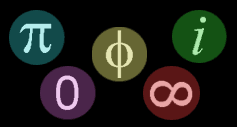
Now, let us look at some of the wonders/puzzles of mathematics. It includes the Fibonacci Number and golden Ratio, the Number ZeroPi, the Imaginary number, and the Infinite number (read more about these 5 Numbers by Simon Singh). Among these, the Fibonacci number is considered part of Nature.

Fibonacci Series

Leonardo da Pisa (aka Leonardo Fibonacci), an Italian mathematician (1175-1250), introduced the Hindu-Arabic number system to Europe, the method we use today with a ten-digit decimal system with the symbol for zero. He discovered a number series where you add the previous two values to get the new value, later known as the Fibonacci series. He wrote a famous book 'Liber Abaci' on how to do arithmetic using the decimal system in 1202.

Here are some interesting facts about the Fibonacci number related to Nature. Let us look closely at flowers; the interesting point is that the number of petals on a flower is often one of the Fibonacci numbers.

1 petal white calla lily flower, 2 petals euphorbia flower are rare, 3 petals trillium flowers are common, Hundred of species of 5 petals columbine flower in wild and cultivated, 8 petals bloodroot flowers are not common but there quite several species, 13 petals black-eyed Susan. The daisy family's outer ring of ray florets also illustrates the Fibonacci sequence. Daisies with 13, 21, 34, 55, or 89 petals are expected. 21 petals Shasta daisy flower. Ordinary field daisies have 34 petals. (
Read more).

Golden Ratio (Phi = 1.618033988749894….)

If you divide any Fibonacci number by the previous number, you will get a ratio of around 1.618… It occurs in Nature at a golden angle of 137.5 degrees (360-360/phi). Take any leaves on a plant; the growth of the leaves on a stem follows a spiral path to the top at an angle of 137.5 degrees. This angle helps the leaves maximize their exposure to sunlight and minimize the shadow it casts on other leaves. Euclid defined the Golden ratio around 300 BC. Luca Pacioli, the 15th-century Italian mathematician, equated the Golden Ratio with the incomprehensibility of God. The most surprising case for the Golden Ratio is its association with Black Holes, a discovery made by Paul Davies of the University of Adelaide in 1989 (read the article '
The Golden Rule').
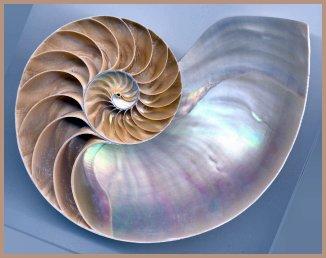
The golden ratio governs the nautilus shell's (cross-section is shown on the left side) growth pattern of its chambers. The Greeks incorporated the Golden Ratio into their Art and Architecture – many of their building, including the Parthenon, are considered antiquity's most perfect structure.
Prime Number

Every positive number is either a prime number or a by-product of Primes. However, it's been ages since we hunted for the formula to predict the prime numbers, and the complete procedure to predict the prime numbers still eludes us. Following are the effects of finding the formula to predict prime numbers.
- The collapse of current cryptography (Public / Private Key Infrastructure) standards (used in SSL / TLS).

- The collapse of Internet Secure Communications (Banking and Credit Card transactions)

Nature & Mathematics

After looking at the above 3 Numbers (Fibonacci, Golden Ratio, Prime), it is interesting to know that Nature still hides a lot of information from us or rather gives subtle clues for us to discover the ultimate truth, and mathematics is one of the critical science which helps us to understand the mysteries of the Nature.

So, as a species, our ability to understand Nature is far superior to other species.

What is the next level of our consciousness? Is it nirvana? Or perfection from the scientific point of view? Are there any species that have achieved the next level of consciousness?

Imagine an entire society in a state of nirvana!

A state where science is frozen while the self blends with the Oneness.

"The reasonable man adapts himself to the world; the unreasonable one persists in trying to adapt the world to himself. Therefore, all progress depends on the unreasonable."
- George Bernard Shaw (1856 - 1950)


Glossary
Prime NumberA Prime Number is a positive integer not divisible without a remainder by any positive integer other than itself and one. Examples. 2, 3, 5, 7, 11, and 13 are Primes.
Mersenne PrimeNamed after the French Monk and mathematician Marin Mersenne, born in 1588. He investigated a particular type of Prime Number 2P-1, where P is an ordinary prime number.
Fibonacci NumberThe Fibonacci number is a series generated by adding the two preceding numbers. Example. 1, 1, 2, 3, 5, 8, 13, 21, 34, etc. Dividing a Fibonacci number by a previous one. For Example., 21/13 or 8/5 results in an answer close to 1.61803, known as a Golden Ratio. 
Golden Ratio1.618033988749894848204586834365638117720……. This unique number represents the Golden ratio, denoted by the Greek letter Phi. The digits of the Golden ratio go on forever without repeating.
PiPi represents the number 3.14159265… which is the ratio of the circumference of a circle to its diameter. An irrational number that cannot be expressed as the ratio of two whole numbers and has a random decimal string of infinite length.


Further Reading
Internet
1. Plus Magazine –
The Life and Numbers of Fibonacci
2. Guardian UK – The Golden Rule
3. Wolfram Research – Fibonacci Number
4. Math Forum – Fibonacci Number and the Golden Ratio
5. American Scientist – Did Mozart use the Golden Section?
6. Web – The Mathematical Magic of the Fibonacci Numbers
7. Web – Fibonacci Number & Golden Ratio in Art, Architecture & Music
8. Web – The Golden Mean in Art (Leonardo Da Vinci)
9. Answers.Com – Fibonacci Numbers
10. Answers.com – Golden Ratio
11. Web – The Golden Ratio
12. BBC – 5 Numbers by Simon Singh
13. Wolfram Research – Prime Number
14. Answers.Com –
Prime Numbers
15. University of Tennessee – The Largest Known Prime
16. Wikipedia – GIMPS – Great Internet Mersenne Prime Search
17. Clay Mathematics Institute – Riemann Hypothesis
18. Answers.com – Pi

Software Products
1. Wolfram Research –
Mathematica 5.2
2. Mersenne.org – Free GIMPS software to search for primes

Books1. Mario Livio –
The Golden Ratio
2. Marcus du Sautoy – The Music of the Primes: Searching to solve the greatest mystery in mathematics
3. Simon Singh –
The Code Book
4. David Wells –
Prime Numbers: The most mysterious figures in Math
5. David Darling –
Equations of Eternity

Tuesday, October 04, 2005

Land of Straight Lines and Beginning of Time

The Land of Straight Lines.

There is a strange planet called Straight Net somewhere in the Andromeda galaxy. So, what is odd or special about it? The land (planet) is built upon objects with straight lines. Which means the planet is a big rectangular land. They play soccer with a cube and rugby with rectangular boxes instead of spherical objects; their body, trees, roads, and animals are built using straight lines.

Now, try to ask straight-lander the following questions. 

1. How do you explain to them about something in a spherical shape (soccer ball, volleyball, etc.)?
2. Can they think about an object which does not have edges?
3. How do you tell them there is a specific shape where you can't specify the object's center (on the surface)?

Here is a conversation with a person from the land of straight lines and a scientist from planet Earth.

Scenario: 

Straightlineman (the person from the straightnet planet) sits on a beautiful couch of flat rosewood. However, he is a little nervous as his new visitor is from another galaxy. What helps their communication is the new intergalactic language translator he bought recently from Salmart stores. His guest didn't find any comfort sitting on the flat wooden sofa either because he knew he would spend some time with the host.

Straightlineman: Hello, you don't seem to belong to this land.
Earthlian: Yes, you are right. I came from a distant place. A place is different than this place.

Straightlineman: Interesting. So, how different is your world? 

Earthlian: Everything looks the same except for one thing. They don't come near me. You are gonna hurt me.

Straightlineman: I don't get it. We are a peace-loving species; of course, there are exceptions. 

Earthlian: You have sharp edges. As a matter of fact, everything in this land is made up of straight lines, which ends up having sharp edges for everything.

Straightlineman: What is so strange about it? Everything in this world is built using straight lines. This whole universe is made using straight lines. Even you are like that.
Earthlian: True. That's because your brain is tuned with the laws of your world. So it rejects things it finds outside that law, and it's projecting my image in a form you can understand easily.

Straightlineman: That's funny. Now you are saying I should not believe my eyes.
Earthlian: You see the mental projection of your brain's interpretation. Your brain interprets much information and filters out information it feels is unnecessary. End of the day, you see what your brain wants you to see. So, even though my image is different, it doesn't look different within the context of your laws.

Straightlineman: OK, OK. No arguments. I need to prove you are right and wrong. However, I would like to understand this new concept rather than try to understand it. (smiles)
Earthlian: Before I explain the new concept, I would like to show you a paragraph (translated to straightnet language by the intergalactic language translator).

"I cdnuolt blveiee taht I cluod aulaclty uesdnatnrd waht I was rdanieg The phaonmneal pweor of the mnid Aoccdrnig to a rscheearch at Cmabrigde Uinervtisy, it deosn't mttaer in waht oredr the ltteers in a wrod are, the olny iprmoatnt tihng is taht the frist and lsat ltteer be in the rghit pclae. The rset can be a taotl mses and you can still raed it wouthit a porbelm.

Tihs is bcuseae the mnid deos not raed ervey lteter by istlef, but the wrod as a wlohe. Amzanig huh? yaeh and I awlyas thought slpeling was necessary."


Earthlian: So, did you notice anything strange?

Straightlineman: Despite the messy spelling, I could read everything correctly on the first attempt. This shows that my mind (brain) interpreted everything correctly when my eyes read it wrong. Now I am getting a feeling where you are going to head. However, I will get uncomfortable with it.

Earthlian: OK, Let us take this step by step. Can you think about a shape that doesn't have any edges?

Straightlineman: Is that a valid question? If you take any shape, let us say a triangle, square, hexagon, pentagon, or any 3-dimensional shape cube, pyramid, anything. Everything has an edge.

Straightlineman: Let us continue this exciting discussion with a cup of coffee. Straightlineman 2
 served two cups of coffee for the stranger and the straightlineman. The cup was made of a cube with the top opened and served in a flat square saucer.

Earthlian: Coffee is pretty good. Let us come back to our topic. Before I answer your query, let me pose another question. Take any of the shapes you mentioned. For example, take a triangle – How many center points (on the surface) will you find?

Straightlineman: Of course, just one central point on the surface, whether it is a triangle, square, hexagon, etc. In the case of 3-dimensional objects, you will find one center point on every side.
Earthlian: So far so good. How about a 3-dimensional object, where you can have infinite center points.

Straightlineman: Infinite number of center points. That's impossible. It is mathematically not possible.
Earthlian: It is possible, however challenging, to explain with the current set of laws.

Straightlineman: By enhancing our laws or with a new set of rules, you can show the mysterious object that may contain infinite center points on the surface.
Earthlian: Yes. Here is a 3-dimensional object made up of triangles.

Straightlineman: Looks interesting. But it still has a lot of surfaces.
Earthlian: Let us add more triangles to this object by reducing the size of the triangles and see what happens?

Straightlineman: It is getting weird. 

Earthlian: Let us add more and more triangles to this object.

Straightlineman struggling to find his breath, he stares at the object and sees a transformation in the visitor. The visitor looks completely different. The visitor has acquired an image that is beyond his imagination.

Epilogue 

Thanks to the magic of triangles ending up as a sphere, in the end, it took great effort to illustrate the concept of the sphere to a person who lived in the Land of Straight Lines.

In the same thought process, is it possible to think about a concept without beginning for Time!

If there is no beginning for Time, then what is the relevance of the concept of past and future?

Are we in a matrix (created by our mind) that imposes the constraint of Time moving in a direction where the past is behind us while the future is in front of us and we live in the present? "
There is no reason to suppose that the world had a beginning. The idea that things must have a beginning is really due to the poverty of our imagination." - Bertrand Russell.


Further Reading

Internet

1. Answers.com - Triangle, Sphere, Geometry
2. Geometry Thru Art -
http://mathforum.org/~sarah/shapiro/triangle.diagonals.html
3. Edwin A. Abbott (1838-1926)
Flatland – A romance of many Dimensions
4. PBS – Time Travel
5. How Stuff Works – How Time Travel will work?
6. Stanford University – Time Travel and Modern Physics
7. Caltech University – Time Travel in Flatland
8. Wikipedia – Grandfather Paradox
9. Absolute Astronomy – Causality (Physics)

* Image courtesy of Intergraph Computer Systems